
Waisai, the capital of Raja Ampat, has grown from approximately 1,000 people to 35,000 in 50 years — a 35-fold increase. The Dampier Strait now receives an estimated 316 tonnes of nitrogen and 39 tonnes of phosphorus per year from untreated domestic sewage. This is equivalent to the sewage load of a city of approximately 72,000 people discharged directly into the MPA.
The ReefSaver addresses individual homestays and households. But the scale of the municipal problem requires a different response. PEP works with the Raja Ampat local government to identify, design, and secure funding for municipal- scale wastewater infrastructure — the missing piece that no small-scale system can replace.
Large-Scale Treatment
Waisai's 35,000 residents generate wastewater volumes that no decentralised system can handle at scale. Conventional treatment plants and constructed wetland systems are the only solutions capable of addressing the municipal nitrogen load entering the Dampier Strait. Without them, small-scale interventions like the ReefSaver, however effective, cannot protect the reef from the dominant source of nitrogen pollution.
PEP works with the Raja Ampat local government, bringing water quality data and practical field experience to help identify, design, and make the case for municipal-scale wastewater infrastructure. This is long-term work. It requires sustained government engagement and international funding support.
Conventional Treatment Plants
Centralised facilities capable of processing large volumes of wastewater from growing urban centres, removing contaminants before discharge.
Artificial Wetlands
Constructed wetland systems that use natural processes — plants, soil, and microorganisms — to treat wastewater at scale, with lower energy and maintenance costs.
Funding & Partnerships
PEP helps municipalities identify and secure funding from government programs, international development agencies, and conservation organizations.
The Economics of Action vs. Inaction
Investing in wastewater treatment is not just an environmental imperative — it is an economic one.
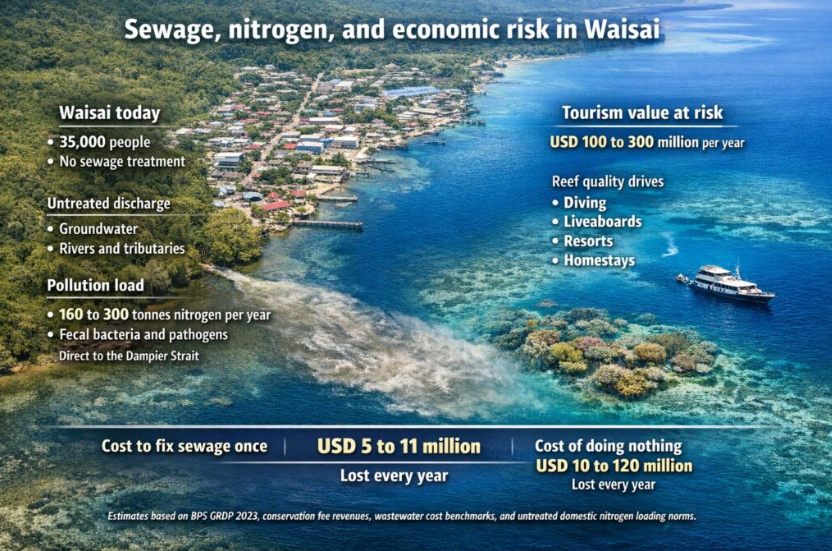
Programme Infographic
DEWATS: Decentralised Wastewater Treatment
Penelitian Ecowisata Papua (PEP) · Wastewater
Decentralised Wastewater Treatment System
Shared wastewater treatment to protect health, freshwater, and coral reefs

How the System Works
At each house
Toilet and household wastewater enters a sealed household bioseptic tank. Solids stay in the tank. No soak pits, no leakage near wells.
Collection
Mostly liquid wastewater flows through small-bore sewer pipes. Gravity used wherever possible.
Village treatment
Wastewater flows to a communal bioseptic tank. One tank or two smaller units if the village is long. Removes solids and organic load.
Health and nitrogen protection
Effluent flows into a subsurface constructed wetland. Wetland reduces pathogens and nitrogen. Planted with robust local plants and vetiver.
Final treatment and reuse
Flow passes through planted gravel filter or infiltration bed. Remaining nutrients absorbed by plants. Safe reuse on land. No discharge to sea or lagoon.
Key Principle
Do not stop treatment at the bioseptic tank. Wetlands and planted filters are essential.
Example in Indonesia
Bioseptic plus wetland system · 300–350 people · Approx. IDR 350–500 million
Optional solar support available where gravity flow is not possible